SLP Chat
This will be a place where therapists can share ideas, problem solve and express concerns. Lets work together to make our jobs easier!
Teresa
Schools still don’t know what we do
May 13, 2024 #5 reflection series
I still find it amazing that so many teachers, administrators and some team members have no idea the extent of our knowledge. They sit in meetings with us, listening to us explain in depth evaluations, progress and service plans and seem to pick up nothing.
Why don’t people know what we do beyond working with articulation skills or getting words out? We are somewhat responsible for this, however ASHA is the bigger problem. Changing our title to Speech Language Pathologist back in the early 80ies didn’t help with clarification. ASHA has never put in specific guidelines about our roles in schools, areas we address, skills we may have or even caseload limits. As a school speech language pathologist, I have always felt abandoned by ASHA and any suggestions/questions/ concerns I’ve presented over the years have fallen on deaf ears.
In the recent past I’ve attended 2 ASHA conventions. I have felt the School SLP was pretty much ignored as a focus, even though I would bet most of the SLPs who attend are school based. Two things have lead me to this conclusion. First, at the last ASHA convention I attended in Boston, I went to the opening welcome session. During that session they went on and on about the good things ASHA was doing mostly medical based, political or international. I was paying attention, the contributions/needs of the school-based therapist were mention only once and that was in passing. I also noticed that any session that I was interested in as a school-based therapist was being held in a space that was too small. Just about every session I attended, I was put in overflow sometimes sitting on the floor. I don’t know too many other professions that put up with sitting on the floor during a professional conference.
We may have to take a little responsibility for not being understood. A big part of the issue is there is usually only one SLP in a building. I’ve only worked in one school system where there was a solidarity among the SLPs, where we could really point out and ask for things. I’ve never been recognized as different from a teacher in a union. Maybe we just haven’t done enough to point out the very real differences in our job compared to teachers. Teachers usually get an hour a day for planning but we often need that hour and more for testing/paperwork. Even if you have an administrator that understands, their hands are tied.
I’ve tried to do some education about our field, presenting a workshop for teaching assistants, writing articles for parents in school newsletters and presenting topics at Ed Camp. I even wrote a book for administrators. You would think hearing us present our reports would clue them in a little. Listening and learning from others is how I learned a lot about motor skills and vestibular skills, perceptual skills and the list goes on.
Some School Psychologists might “get” what we do but it really doesn’t impact them so much. They present their report and we’re left to follow up. The rest of the team….few read our stuff, less than few take notes during meetings or even ask relevant questions. Schools just know they have to have us on staff. They don’t like the fact that we overlap with medical (which is a much bigger deal in schools than most even know). I do believe that’s where we run into problems, we know so much tied into medical. It is amazing they sometimes don’t even see that there might be a connection with learning.
Side Story….
I’ve approached so called reading specialists pointing out that students are missing key underlying skills (never in a meeting but off to the side). It was like talking to a wall. They seem to have little understanding how underlying listening, memory, auditory perceptual skills and other skills affect reading. They put students in whatever reading program is the flavor of the day. A couple of years pass, the reading specialists try a few other programs by then the student is in 4th grade and barely reading because the underlying skills were not addressed. Now if you are a therapist that has dual certification or just a vast knowledge in reading be careful because, if they do finally see the light they will have you doing the work of two. (My thoughts on our role in literacy will be discussed in a later reflection article)
Side story…..
At one ASHA convention I went to the Sig meeting for school therapists. They stood up there and went on and on about school therapists getting more involved in the Sig. They felt sure our districts would give us time off to be involved. The therapists were too polite to laugh out loud. However, are our jaws hanging open. No school therapist is going to have time to sit on a committee and few if any schools would allow even unpaid time off for such a venture (I’m not sure ASHA knows we are mandated to see students as scheduled). The ASHA reps were so far off base in regards to the school SLP. The SLP’s attending the meeting couldn’t wait to get out of there since there was nothing of substance discussed.
So after the meeting I go up to talk to the ASHA reps and to give them a copy of my book. It was not a warm reception. I ended up talking to the one rep whose husband was a school administrator. You would think I just insulted the man. It was just so clear to me that ASHA was also either clueless, had little to no respect for the lowly school SLP and frankly didn’t want to change. Plus they clearly did not want to make connections even with someone advocating for the school SLP.
Side Story…..
These days I don’t run into too many syndromes, medical issues or disabilities that I have never heard of before. In the recent past I was seeing a student with Tubular Sclerosis. That was a new one on me. Now before sitting down with the team I did some simple research on the disorder. Discussing things with the team I was surprised to hear that no one at the table really knew what disease entailed. I had just showed up on the scene and they had worked with the student for 3 years. Not that it really made a difference in how this student was serviced. I was just taken aback that know one was curious enough to research the disease. Research is so easy these days why wouldn’t you. My brief research explained so much to the team.
My Advice: We have a very large scope of practice. Do your best to try and explain your role in schools as situations arise. That is really all you can do. Don’t wait till you’re old and brave to speak up for yourself. Don’t take on extra roles, even if you have the expertise. Don’t work on reading and writing as formal goals/objectives. School SLPs are not given the time in their day/week to address reading and writing efficiently.
Would I do it Again?

May 7, 2024 #2
I have frequently asked myself if I had to do things over again would I become a Speech Language Pathologist. The answer is I really don’t know.
First you have to understand that when I graduated from high school in 1979 women in general still didn’t have (or knew about) as many options as they do today. At my all girls high school we were put basically on 3 tracks, medical/science (which meant nursing, although one of my besties from HS became a doctor), educational or secretarial. I knew I did not want to be a nurse and had no idea how important secretarial skills would become so that left education. Growing up in the neighborhood I did we really didn’t know about the larger universe or the intricacies of certain fields. In my neighborhood the Dads were building cars not designing them. I had no idea there was even a field called engineering. The only engineer I knew drove a train. I only knew about speech therapy because I had a younger brother who had severe dyspraxia, so my mom (a nurse) knew a little about that field.
When I applied to college the major was still called “speech therapy” and Eastern Michigan University offered one of the first 5-year masters degree programs in the country. While I was in college the title changed to “Speech Language Pathologist” and masters was required. By this time I was excited about the new things I was learning. However, looking back I probably would have been excited about learning things in any field. I remember one class that did interest me more than others and that was Acoustics of Sound. I thought briefly about becoming a sound engineer but did not feel I had the math abilities to do it. Perhaps if I had known more about the field of sound engineering I maybe would have considered it a little more seriously.
One other piece about college that kept me from veering off the SLP tract was time and money. If you took another class of interest that meant that it would cost more and you could feasibly have to be in school another semester. I don’t know how it is now but back then courses/student teaching and internships were so packed/planned you really couldn’t go off track. With the high cost of education I imagine that the pressure to stay on track is even more today. Speech Language Pathology course credits don’t really carryover to too many other fields.
So was I stuck? Yes, I was but at least there were a lot of different things you could do in the field. The hours were not bad. You could get a job anywhere.
What really made me rethink things was after being in a few years I realized that I really wasn’t valued in the school setting. We are still seen as a requirement not an asset. I also realized that if I worked hard it was only going to give me intrinsic gratification. I do love helping others so that was wonderful. Then I realized I wasn’t ever going to make enough money to really support myself unless I worked a million hours. Keep in mind this was long before most people were thinking outside the box and being creative. I would never in my career get a bonus. Advancement without going back to school was never going to happen no matter how hard I worked. Not to mention in schools there’s nowhere for an SLP to go. It would mean a job change to advance in schools.
My own work ethic made me put in too many hours, spend too much of my money on materials/supplies and never saying no (I will have a post on this one) and caused some significant stress when dealing with administration or contentious IEP situations (mostly caused by schools not servicing kids properly).
My Advice: I think I would do this again probably because I wouldn’t have known any better at the time. I love working with kids and families. I love being at the top of my field and very knowledgeable. I wouldn’t recommend going into the field of education at this time for various reasons. The hours did work out well for me, especially when I was raising my kids. I was lucky I had a husband with a great income and access to much better benefits. However, if I understood the economy better back then the low pay and so little chance for advancement, would have made me think twice. If you are already an SLP, open that private practice sooner or find some other way to supplement your income using your vast knowledge.
What have I learned as a Speech Language Pathologist the past 40 years? A Reflection

44 years ago I embarked on my career as a Speech Language Pathologist. When I started college the course of study was still called the Speech Therapy program in the school’s catalog. By the time I finished the program changed to the Speech Language Pathology program and a Masters was then required in order to work. Eastern Michigan University was proactive with the change and I was fortunate enough to enter one of the first 5 year master degree programs in the country. Most of the “Speech Therapists” at the time knew they were going to be grandfathered in but it was still an issue for many. Basically we were also rebranded and at that time the distinction was Speech Therapists didn’t have a masters and Speech Language Pathologists did. With that said even back then people were saying that the term Speech Language Pathologist was an odd moniker. I couldn’t imagine that 40 years later our role in schools would still be loosely defined with most administrators not understanding our skill set. I’m often called the “speech therapist” or “speech teacher” and you know what it doesn’t bother me too much. I will however introduce myself as a speech language pathologist in meetings.
So I graduated Eastern with a masters degree and added the letters SLP after my name. I was on my way.
So now it’s May 2024 and a lifetime since I started working as a Speech Language Pathologist, 39 years to be exact. While I started my career in early intervention, most of my work has been in the public schools with some private practice on the side. In 2016, I stopped working for schools as an employee (I had had about all I could take) and went exclusively into private practice, contracting to schools instead.
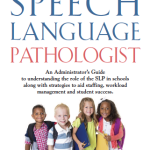
While I’ve loved working with kids in schools, I’ve tried to vary my career just to do a little something different and to expand my skill set. I have been blogging on and off since 2007. My first blog was Your Middle Schooler: A Unique Age and my second blog is this blog The School Speech Therapist. I also wrote a book for school administrators called The School Speech Language Pathologist an Administrator’s Guide to understanding the role of the SLP in schools along with strategies to aid staffing, workload management and student success, it wasn’t received well. Blogging was and is a lot of fun, saying I wrote a book sound cool but the actual writing was a lot of work for very little return. Plus I’m beginning to realize that blogging alone is perhaps a bit outdated these days.
As I’m pondering retirement I’ve decided to close out my blog sometime in the near future. However, always the person who wants to share their knowledge and expertise, I’ve decided to write a series of articles reflecting issues I’ve faced as a school SLP and the joys I’ve experienced as a school SLP. I want to be able to impart my wisdom to the masses. No really, my objectives would be to share what I’ve learned from experiences, provide guidance to help any school SLP avoid pitfalls, provide practical information, point out my concerns and share some of the good times. I will admit that like my book this is probably going to be a bit of a therapeutic assignment for me. I hope it will also help me remember that I did sometimes make a difference in the life of at least a few kids.
During the month of May, which as we know is Better Speech and Hearing month, I plan to post an article a day (yes I am a few days behind already). Now I know Better Speech and Hearing month is supposed to be for us to provide information to the community but this May I want to provide information to my SLP community.
I have a variety of topics planned. However, if you have any specific topics, situations you want to ask about, any questions, concerns you’ve faced or just a fun story to share, I would love to hear from you. Email me at teresa@tbsspeechtherapy.com
Please indulge this aging SLP and follow along through the month of May 2024
By the way, my domain name may be going up for sale at some point if anyone is interested.

Thinking about COVID 19, Schools and Speech Language Pathologists
To all you Speech Language Pathologists working with unreasonable caseloads now is the time to advocate for yourselves and your students. Think a lot about this as the guidelines for the “new normal” start coming out in every state.
This week in Massachusetts the guidelines for what school is going to look like were released. It pretty much encompasses what I expected it would. Earlier guidelines came out for summer opening only a couple of weeks ago. Both these documents provide very generic guidelines and both read as if the people who wrote them have never spent a day working in a public schools or even remember going to school. Again it is one more document that clearly shows that they do not know the role of the SLP in schools and how we work with kids.
According to what I read, here are some take-aways from the guidelines:
- Physical distancing-Students should be kept 3-6 feet away from each other and all face the same way. I don’t know about you but I have never been put in a space where social distancing was possible with a small group of 3-4 students.
- Limiting travel within a school-We have to pick up and return kids, we travel around the building constantly. I wonder if we are even going to be able to see kids in small groups.
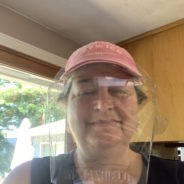
- Based on what I read it appears that we would have to use a mask and a shield because face it we work closely with kids and spit flies
- We need to prepare for remote learning just in case. Well I did get a little experience with that during this last shut down. The three factors that seemed to be the biggest problems were my lack of training, not enough time to see everyone (since on line sessions have to have time cushions on each side and small groups are really not feasible) and lack of materials. I was able to convert many of my materials to on line but that took a lot of time. Will teachers and therapists be given the time to basically develop a whole new curriculum or find/buy/create new on line material? Will schools pony up for the cost? (As a side note, which has bothered me since shut down. Where, are the common core people on this? If common core is so great and so important why don’t we have an on line version with materials ready to go. Schools have incurred considerable costs trying to piece something together to get through the year. Why doesn’t the department of education have an on line platform ready to go? Not that I want this since I am not a fan of common core but really why does every school district in the country have to reinvent the wheel during a crisis?)
I think that those 4 points alone will make it impossible to service extremely large caseloads. Now is the time to approach your administrators and talk about your concerns not in the fall because they will be totally overwhelmed.
Beyond the 4 points mentioned above I have some personal concerns you might also want to point out
- How am I going to clean my materials and my room? Does the room need to be sanitized after each student or group? Where is the time to do this if your schedule is back to back? Will someone be hired to help with this? Will you be given adequate cleaning supplies that actually kill germs and absorb? Where is the nearest water supply to wash hands and help with cleaning? Say you regularly see 8-10 groups a day and you work in the office in between when is this cleaning suppose to take place?
- How effective can Speech Language Pathologists be with everyone in masks? I think that is a valid question. How do you work on articulation and pragmatics when you are wearing masks? Is it possible to just wear shields during therapy?
- Masks add a layer of distraction and your perception can be a little off both to the sides and down. This will affect all learning and coordination for some.
- Scheduling will be next to impossible, yet we will be on the hook if the IEP isn’t followed. Specifically ask you administrator what is expected and ask them to make a schedule for you. This is something I recommend all the time and it is the only way school admin will ever know the obstacles we face. Be very candid about the time you will need for assessments, IEPs. progress notes and added cleaning. Assessments will be up this year because many were skipped during the shut down.
- If kids don’t come to school every day, what will services look like? Can IEPs be followed if the student is not in school everyday? Will IEPs need to be rewritten?
- On line therapy seems to be the best thing since sliced bread. It is a good alternative but it has its limitations. There is no way I was as effective especially without experience, training and resources. On line therapy has been around for years, it’s a specialty area. It really hasn’t taken off like you would have expect to and there is a reason for that. So much of what we do needs to be hands on. One point that was sorely overlooked during the covid shutdown is that when you do on line therapy there needs to be another adult either with the student to facilitate/monitor or another team member in the session with you. Every in-service I have listened to has pointed this out as a safety measure.
No, I would not want to be the one who have to put any state guidelines together and I do understand why it has to be done. The guidelines from Massachusetts looks impressive, citing almost 4 pages of research but I always question the validity of the research. Is the research they used to come up with the guidelines reliable? I hope so but that doesn’t always happen with research especially now when there is so much question with the covid data and numbers overall. Could the guidelines be picked apart? Easily. Do the guidelines often contradict each other? At times. I think it will be interesting to see how guidelines vary from state to state.
Speech Language Pathologists will not be able to function in the same way given the “new normal”. We as a profession should be deciding how we do our job along with what makes a reasonable caseload (within the guidelines being presented) and not let school administration tell us what our jobs will be. I believe the guidelines are somewhat generic so schools have some leeway on how things are implemented. Just note if you were handling a caseload say even above 30 before covid, you will have a challenging time meeting the needs and the IEPs of these same 30 kids. You may be doing both in school and on line therapy. Department of Education will get around to looking at what was provided and what wasn’t. When that day comes it will not be pretty. Just make sure you keep in touch with your administration on what you are able to provide within the limitations of a school day (whatever that looks like at your school) and documented it. Say NO if you can’t take on more or can’t manage with the new restrictions. When possible provide administration with solutions that might work. Work as a team with other speech language pathologists in the district. I rarely see this happen but when it does it is a very good thing.
We will get through this, no choice we have to. However, how you get through this is up to you. I feel being proactive will make the situation a little bit better in the long run and your position in schools stronger. Working with other SLPs in your district will frankly give you more autonomy and a bigger voice. It is up to you to advocate for yourself and the students you service.
Schools have to get back to normal in the fall….not the “new normal”

***I actually wrote this article about two weeks ago and did not get a chance to post it. Since then the powers that be are hinting at how Covid will effect summer services and school next fall but nothing seems definite yet.
Just about every news outlet is starting to do stories on what school is going to look like in the fall. The buzz word “new normal” seems to be the current catch all phrase starting to surpass “we’re all in this together but apart” (another phrase which is being use to calm people fears, face it we are alone in this and most of us are looking out for number one. But that is an article for another day). All kinds of crazy things are mentioned in news trailers and in on line articles. I just hope the powers that be use some common sense when deciding on what procedures will be used in schools. After over 30 years working in the schools and what I’ve heard about and observed the past 3 months I can tell you this….students need to get back to normal not a so called new normal. It’s the schools, administration and adults around them that will have to make changes.
During this time of shut down there is no doubt that student’s have suffered. Most schools and teachers have done their very best but few had the immediate means and the skills needed to truly implement on line learning. Add in a layer where some many parents do not have the skills, desire, time or programming to help their child. Add in another layer where students may not have the technology needed for successful on line learning and on line learning clearly can’t work for many. Those are just surface concerns. Some student’s and parents need the structure of school to be successful. For many years to come scholars will be debating whether on line learning vs. paper packets vs. no school at all made a difference. They will be looking at gaps in development, studying skill levels of parent and skill level of teachers to teach remotely. I see many theses and many dissertations coming out of this.
So how do we get students back to a normal school experience? Keep in mind my suggestions are based on a situation where there is no active spread of covid 19. But let’s face it kids have picked up various bugs (and literally bugs) from other kids for years and they will continue to do so. It’s not bad to catch a few germs and some will argue it is actually a good thing. We can’t keep kids clean and tidy all day if we don’t want them to grow up with a complex and a poor immune system. Most kids like to play and get dirty and some will tell us that dirt and germs are a good thing.
How clean are schools?
In most schools I’ve worked in schools get a deep clean over the summer and maybe during longer breaks but other than that it is a daily surface clean or a spot clean. When only a couple of people are hired to clean a whole school in a 4-hour window, just how good is the school cleaned? I’ve also questioned the types of products most schools use. I think in the past schools usually have purchased the cheapest products and water down the product. If there isn’t a head custodian overseeing cleaning in the district, principals need to take ownership of cleaning schools and frankly they miss so much. I worked in one school where the doormats did not get cleaned for 2 years and that was just one of many things that were not properly cleaned.
School Bathrooms
School bathrooms usually only get the once over at night, toilets and sinks. Boy’s rooms often smell like urine, stall walls and locks are hardly ever touched with a rag. Basically, school bathrooms need to be cleaned thoroughly several times during the day. Think of how many people (little ones without the best habits) are using a single bathroom on a daily basis. Deep cleaning at night with a strong bleach or other equivalent product is a must. Students may need some instruction on good bathroom habits and expected behavior in a public bathroom. Just about any time a little one uses a public bathroom outside of school they are accompanied by an adult. We assume they know what do but many don’t. Perhaps buying some paper towels that actually absorb might help too.
The Nurses Office
Usually a pretty clean place but again it does depend on the nurse. There should be standards and should be disinfected/cleaned at some point during the day. Sometimes some really sick kids spend hours in there. The biggest problem isn’t with the nurse’s office per say it is with parents sending their kids to school knowing they are sick. That happens a lot more than you think. While I don’t think you would be able to punish/fine the parent, they should be expected to show up ASAP. I have noted that with the rigors of common core, parents and students are often afraid to miss school because they will fall behind. Not sure what the solution is there but it should be easier to catch up if you are out sick. Schools need to try and create a separate place for sick student’s to be observed until their parents show up. Nurses have a really tough job determining which students are really sick and which students want or need attention. Nurses need to get parents and counselors involved if they suspect students are coming to them often for attention.
The Cafeteria
Frankly I’d be more concern about the lousy food with poor nutritional value served in most school cafeterias than catching something. However school cafeterias are pretty gross. Not so much the food prep area (I say food prep area because few schools actually cook food anymore) but I am sure the food prep area could use a better cleaning at night. The cafeterias themselves are pretty gross, often dirty and loud. Kids usually have 10-15 minutes to shove in their food and move on. Spot cleaned at best during lunchtime, surfaced cleaned after lunchtime. I usually see rags in a bucket used to clean seats and tables between grades. Children often have to bring their coats with them and guess where they end up…on the dirty floor. With that said, lunch boxes often spend a lot of time on the floor during the day. So many kids come to school with lunch boxes that are filthy inside and out. School cafeterias have functioned like this for my entire life but there has to be room for improvement.
The Gym
Students spend a lot of time in gym class and sitting on the gym floor for various assemblies. At best, they gym floor is dry dusted once in a great while. In most places, kids are wearing their street shoes into gym class. I remember having to change into our sneakers before gym class. My gym teacher probably did that for two reasons, that way we always had sneakers and it also kept the gym a little cleaner. Public schools can’t expect kids to keep shoes at school anymore and a lot of students couldn’t change shoes efficiently these days. Gyms need to be cleaned more often and better ventilated. I’m going into brand new schools or new gyms where they are basically sweat boxes with a single door for ventilation. While challenging, wood floors have to be sanitized at some point and dirt needs to be cleaned up.
The Classroom
Anyone who thinks you can social distance in a classroom is living in a dream world. However, this is an opportunity to advocate for decreased classroom size. If you ask students to wear a mask all day, you’ll probably create a bigger germ problem than you have in the classrooms now. All I envision is cloth masks that never get washed, touched constantly, decreased attention and in the end the masks will up on the floor half the time. If you put up desk separators they will fall down all the time, kids will miss a lot of instruction, naughty behaviors will emerge from behind the curtain and quiet kids will be missed.
Water bottles are right up there with lunchboxes in terms of how gross they are. Some kids chomp on them all day, some are rarely washed and most end up on the floor at some point. Water bottles came into favor after the H1N1 flu closed down the remaining working fountains in schools. Parents were worried that their child was somehow going to dehydrate severely at school and schools went along with it. Water bottles wouldn’t be so bad if they were used with some polite expectations and kept in a clean place. Water filling stations are the new drinking fountains. Sounds like a good idea, until you actually watch the students use the filling station. Most put the lip of their bottle up to where the water comes out, touching the spigot. Again this is where some education is in order or schools will have to monitor usage.
Kids who come to school a little on the dirty side might need a bit of help. These kids are usually ignored in school either because adults don’t want to put them down or adults just don’t want to get involved. Reality is these kids need some discrete help by either talking to them, taking them to the nurse or counselor for help or by helping them get cleaned up. Keep in mind there are kids who are very clean when they leave in the morning and show up to school dirty and kids who are living in not so great surroundings. Schools need to learn to tell the differences and have a consistent plan to help these students. Certain kids are also going to show up clean when they get to school and look really grubby when they leave school. It is just their nature.
There are sinks in some schools and hand washing is better than sanitizing. However, the sinks are usually filthy and like bathrooms need to be cleaned several times per day. Again kids need to be taught how to use soap and wash hands properly.
Desks and tabletops should be cleaned at the end of the day. Dirty chairs should not sit on top of desks. Classrooms should be decluttered so make cleaning at night easier. Doorknobs should be wiped down. However, using an ineffective cleaner and those brown paper towels will do nothing. Things like books and keyboards will be germy, that is a fact of life. Unless you want to put kids in a bubble and end up with weakened immune systems they have to take some risks.
Heating systems and ventilation systems need to be repaired and updated. Here in the northeast the first few days in September and the last days in June (well not this year) are usually hot as blazes. Basically, turning schools into hot stinky messes. In the winter I’ve walked into classrooms where rooms were so hot the windows were open. Those classes were like being in a petri dish. Then the classroom next door was so cold the kids noses were red.
My biggest fear
My biggest fear is that those that work closely with kids in schools will not be able to touch kids at all. I mean things like holding a little ones hand, comforting a child with a hug, giving high fives for good work, giving a pat on a back, guiding a child down the hall, buddy hugs or even a well deserved/needed hug. I can’t tell you how many times I’ve received an unexpected hug from a child and if I can’t hug back or have to stop a hug, I will be heart broken.
Here is what I expect will happen
Schools all over the country will put unrealistic and absurd guidelines in place. These guidelines will be severe and a knee jerk reaction to the current situation. Most will be based on the personal fears of the administration, pandering to parents or what other schools are doing. Not on evidence based science or even common sense.
I think these guidelines will fade quickly over a short period of time, even the guidelines that do make sense. Schools will be cleaned properly for a few months and then they will fall back to their old ways. Principals will tout how clean their schools are citing the bathrooms or cafeterias but the rest of the building will be neglected. Schools will buy the effective more expensive cleaners and other supplies but will be taken away the next budget cycle. They will pay for extra custodians for a year or so then the budget will cut them out too.
So I sound cynical but I am basing this on recent history. Every time there is a school shooting incident administrations, teachers and parents jump on the bandwagon about school safety. There is always a lot of training and lot of plans. Basically, these become band-aid measures and procedures put into place, most not permanent. Within a few months, we find doors left propped open or unlocked, strangers not being questioned as they walk through the building, broken camera systems, communication systems not being updated as promised and people being buzzed in when they really don’t know who they are.
There is going to be a lot of fall out when the shut down is over. Parents who are not happy will address school boards; school boards will blame administrators who will in turn point fingers at principals. Principals will then throw teachers under the bus. Right now every realizes that the shutdown is nothing that could have been planned for and that everyone is doing the best they can with limited knowledge working in technology and having to recreate their content and materials to fit on line learning. 6 months from now people will forget the challenges and ask why schools couldn’t do a better job. I predict there will be a lot of changes with administrative staff because of the finger pointing. However, the administration and principals will be looking for smaller schools and districts to work for.
Basically schools need to improve the cleanliness of buildings, help/encourage basic hygiene for student and parents, budget for increase custodial staff/cleaning supplies and fix heating/ventilation systems. This may not solve all the issues but it is something to think about.
How are school SLPs handling their caseload during the Covid 19 crisis?

We’ve been out of school now for 4 weeks here in the northeast because of Covid 19. While I only have a small private practice that I put on hold, I have been wondering how school speech language pathologists across the country are managing their caseloads, especially those therapists who are put in positions where they have 30-50-80+ students on their caseload. Even when working in schools some very creative scheduling, often with help from an SLPA, has to take place to manage a large caseload.
If you’re an SLP with a large caseload you’re often seeing kids in groups of 3-5 (basically each student is getting 6-10 minutes per session to work on their specific skills, less if you’re a big data collector). I think of these as Band-Aid services, doing just enough for the students to say they’ve been to speech therapy. Now I am not criticizing because I’ve been in that position and I know why/how SLPs end up in that position. That’s a conversation for another time. However, after this is over I hope SLP’s use this experience to help advocate for lower caseload numbers.
Teletherapy sounds like the perfect solution on paper. I imagine school administrators might think this is easy peasy. I participated in a day long in-service on teletherapy and it seemed to be working well for those presenting. However, it was clear that the presenters honed their skills over time and were basically experts in teletherapy, the same way many of us are experts in articulation/oral motor, working within a specific population or literacy. This was not a step by step conference on how to set up teletherapy but more about how it can be used and aspect that need to be taken into consideration.
I actually thought some of the advanced things the presenters were doing within the teletherapy format were very cool and innovative. However, a few things were pointed out (either during the conference or in conversations among other SLPs) that were significant that I can bet school administrators haven’t even taken into consideration when they tell their SLPs to just do teletherapy.
- Rural and lower economic students may not have the internet access or updated equipment to participate in teletherapy.
- Parents need to have significant buy in and need to be present during teletherapy sessions. First because they have to be able to help their kids connect to teletherapy, second they may have to be facilitators for their child to access therapy and third is a safety issue, you don’t want to be alone on line with a student of any age.
- Seeing kids in groups during teletherapy is tricky. Even with the so-called relaxed rules around HIPPA because of Covid 19, permission is needed to see kids in groups on line. With the parent factor, you really never know if parents have history with each other. Plus do you really want parents to find out that you see their kids with so many others?
- Because there are only so many hours in a day it will be almost impossible to follow any IEP to the letter of the law much less with students who receive extensive services. When all this is done it looks like parents will be allowed and entitled to request compensatory services. I can’t even imagine what that will look like for some, even if only a few parents take advantage of this.
- Bottom line is, it is impossible to see large numbers of students through telepractice
- There will be technical glitches on both ends. Right now I’m reading about a lot of glitches. I assume this is primarily because of volume and many people who are new to the platform that don’t know how to troubleshoot. Is your school IT team prepared to trouble shoot these glitches, calling parents if needed?
- If a glitch happens, do administrators realize you’ve lost a session and how much time went into troubleshooting. Is there a plan B if the teletherapy platform chosen won’t connect? (This week my personal PT had to use a different platform, connecting through her phone, using her personal number).
- When using teletherapy it is unlikely that you will be able to schedule students back to back. If a half hour session ends at 9:59 you are physically unable to make the connections and be ready to go for your next client/group at 10:00 on the dot. If you do get behind, you have no secretary to call and let the groups know. (Again not criticizing because it has happened to me, during traditional therapy it often happens that once you’ve dropped off and rounded up the next group of students you might be 5-10 into the next session). Scheduling half hour sessions 45 minutes apart seems to be the norm to avoid getting behind.
- Until you get very good at teletherapy and build up appropriate materials, teletherapy prep is going to take some time. I would imagine in some cases a pre-email is sent with materials to print out. While that is time well spent, unless pointed out to administrators they will not even think about it.
Do phone calls and emails work any better? Perhaps in some cases, who knows? These are very unusual times. I think most people are grasping at straws and trying very hard to make remote learning work. My thoughts are that teletherapy has a better chance of working well in a private practice or clinic setting. If a school wants you to try teletherapy and sets up/pays for the platform, offers at least minimal training and want all district SLPs use the same teletherapy guidelines, try it out and consider it a learning experience. Keep track of the pros and cons so you can report on it later. Also keep track of all contacts with parents and students phone, email or teletherapy.
If your school administration is leaving it up to you alone to set up and use teletherapy, I would say no. That type of situation just leaves you hanging, especially if you don’t carry your own personal liability insurance. I checked with Trust Risk Management, my liability insurance provider and my policy covers teletherapy. Without school investment, there is no IT support when you need it. If something goes wrong you will be blamed. I’ve worked in schools long enough to know that when this is all over the blame game will be massive, so be prepared.
I would love to know how school SLPs, especially those with large caseloads are managing. Please comment on glitches and successes. Is teletherapy even the term schools are using? Did your school jump into on line learning too soon without the proper research/training? One other thought …it’s too bad CEU’s are not available for those of us who are working on developing our skills in the use of teletherapy. So many SLPs and educators in general are putting a lot of hours in to developing a totally new skill set. I will bet that in the next few years teletherapy becomes a graduate course.
The Marshalla Guide: Book Review
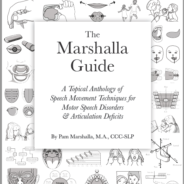
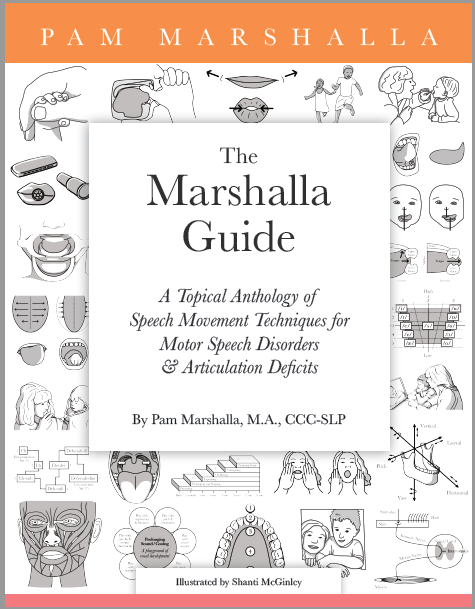
I was recently asked to review a new book. The Marshalla Guide A Topical Anthology of Speech Movement Techniques for Motor Speech Disorder and Articulation Deficits By Pam Marshalla, M.A., CCC-SLP. Being fairly familiar with the quality of Pam Marshalla’s previous works and using/owning many of her books myself I jumped at the opportunity to review her new book.
The Marshalla Guide is basically Pam Marshalla’s life’s work in the areas of oral motor and articulation. Passing on Pam’s knowledge, research and remediation strategies in a structured and well organized manner, the Marshalla Guide covers all things articulation. While in the process of reviewing this book I’ve already used it to refresh my knowledge on lateral lisp, jaw stabilization techniques and other ideas to achieve stimulability of challenging error sounds.
The Marshalla Guide is a pretty big book, almost 500 pages, which might appear overwhelming to some. However, scanning/reading the book I noted that there was quality and valuable information on every page. Finding what you need is not a problem at all. At the beginning of the book Pam Marshalla references the history of articulation therapy and traditional therapy methods. This was a fun read for me because Pam Marshalla and I would have gone to college around the same time and it was exactly what I was taught. I always felt that knowing this underlying history and evolution of speech language pathology in general has helped me build on my skills as a clinician.
Throughout the Marshalla Guide there are therapy techniques, guides, strategies, explanations and specific activities to aid just about any oral motor or articulation situation you may encounter. For me some of this was a good review but I also noted several new strategies and theories to apply. My first impression was that this would make a fantastic college text. Not in dry sense of the term college textbook but in a more meaningful way with practical application. I wish The Marshalla Guide had been on my shelf the past 35 years. It would have increased my confidence around providing appropriate oral motor and articulation therapy in many complex situations.
Who knew there was so much to know about oral motor and articulation? Well, speech Language Pathologists do and so did Pam Marshalla. She was able to take her training and extensive knowledge and organize it in an extremely helpful and user friendly way. You won’t need any other books on articulation therapy other than the Marshalla guide. It is a book you will keep on your shelf forever. A+
***The Marshalla Guide is available at Marshalla Speech and LanguageA launch sale is going on now with 10% off until April 30, 2020. Get an additional 5% off using the promo code schoolspeech.
How do administrators and teachers perceive language disabilities?

It has been quite awhile since I posted anything. I apologize for that. No real excuses, except that writing a blog is a job in itself. Plus I think I have been a little disillusioned with the field. However, I haven’t been sitting around feeling sorry for my situation. After 30+ years in schools I’ve made a positive change. I’m still running my own small private practice and it has been going well. I take on a few private clients and a school contract here and there. It has actually worked out well and I’ve learned a lot working as a consultant in a variety of settings with a variety of teams.
The other day I needed another half credit hour to renew my license. I found a one-credit course through Northern Speech Services called Perceptions of Children in Speech Therapy-What the SLP needs to know, presented by Rhonda Wojcicki, MS. CCC-SLP. Initially from the title, I thought it was going to be about the perceptions of the students who have to attend therapy but it was even better. It was about how administrators/teachers perceive students with speech and language disabilities. Which as you might know ties in with the information in my book The School Speech Therapist-An Administrator’s Guide to understanding the role of the SLP in Schools along with strategies to aid staffing, workload management and student success
After this short well researched on line course I got to thinking. I’ve always known that most administrators have no idea about students and their disabilities. I’ve also know that most administrators have no clue about the Speech Language Pathologist role in evaluating and treating students with language disabilities, along with all the duties that come with that. My book published 2015 was written and published specifically for administrators regarding the role of the Speech Language Pathologist in schools. My book on touches on the types of students we service and their disabilities but it was more about what SLPs do in schools. This course made me realize that we might have to take things a step back, focusing more on educating administrators/teachers around language disabilities before focusing on what the SLP needs to manage their workload.
It was wonderful to listen to a course that basically drew the same conclusion I have over the years, that most administrators and teachers have little understanding how language disabilities (and disabilities in general) impact learning and life. My own observations tell me they also have difficulty understanding how proper support and therapy can help students with disabilities. If this was understood SLPs would not have such high caseloads, specific time would be built in for therapy, co-teaching models would be better, younger students would receive therapy more often, higher order language disabilities would be a priority and the list could go on and on.
Basically if administrators/teachers had a better understanding of language disabilities, child development and success with appropriate interventions, SLPs would not be spread so thin in schools. Our contributions in meetings would hold more weight, students would receive therapy more often and we would be consulted on a regular basis.
Several years back when Response to Intervention (RTI) was becoming a thing, I worked in a school that tried to raise the level of understanding of language disabilities with teachers. This was actually a good thing but it wasn’t done well and we had difficulty getting teacher buy in. There were some a-ha moments for the teachers I worked with at the middle school level but they were few and far between. Needless to say principals and administrators were not part of this training.
Lack of understanding of speech and language disabilities is nothing new but in the past our knowledge and role was more respected. Over the years the role of the SLP in schools has become more technical but we forgot to tell people that. When I first started working my caseload primarily consisted of students working on grammar and articulation, with a much smaller overall workload. Now a public school caseload will consist of students with mild to severe language needs covering the whole spectrum of language/learning disabilities. Students use to be sent out for more in depth testing to hospitals or clinics. Now we do it all. I remember that the hospital/clinic testing always held more weight in meetings even if the SLP was the only one at the table who really understood the findings. It was a good bargaining chip for students to receive increased speech and language services.
Now we do the same testing and yet often the team does not validate our findings. In some cases we are not even allowed to spend the needed time to present our findings and explain things to the parents. When we do get a chance to explain speech and language findings, rarely is anyone taking a note, commenting or asking a question. I often wonder if any of the accommodations or goals are read, much less followed or addressed in the classroom. In years past, SLPs could at least count on the special education teacher or school psychologist having some understanding of language disabilities but that has seemed to wane.
Why do administrators, teachers and other team members have such a poor understanding of why/how underlying language disabilities impact learning? Even if it wasn’t part of their initial training, wouldn’t years of sitting in IEP meetings, teaching children at all levels and talking with the SLP increase their levels of understanding to the point where they could say “I think that student has some sort of underlying language disability”. For a lot of teachers and administrators it hasn’t. I have several thoughts on why this has happened.
- Teachers have a lot on their plate with little support
- You can’t easily “see” language disabilities
- Teacher training even in this day and age, years after integration was the norm, still does not prepare teachers for the disabilities they may encounter in their classrooms
- Many years ago administrators were told they had to immediately integrate special education students with little understanding of disabilities, little to no training and no viable plan. Many Administrators still see integration as a blanket policy without considering individual needs or teacher’s ability to do this successfully.
- If a teacher suspects a disability they basically have to jump through hoops, take copious data and try several accommodations (often without guidance) before referring a student through the RTI process. Once in the RTI process it is often a lot of work for the teachers. Not to mention precious time where the student could be receiving more appropriate services is lost and the child continues to fail. I have known teachers to avoid the RTI process by telling parents to directly request an evaluation. This was evident at one particular school when several evaluation requests came across my desk after the first parent-teacher conference several years in a row.
- In the past administrators have often come up through the ranks and would have a lot of experience actually working with students. Today a lot of administrators go right into administration without any experience working with regular or special education students.
- Administrators running special education programs either as the head of the department or as team managers are not always required to have any special education experience. My observation is that team meetings are run very differently depending on the level of special education experience/understanding of the team leader.
- Schools offer very few continuing education opportunities having anything to do with language development. They have experts in the schools so why don’t they use them.
- Special and regular education teachers are expected to focus on curriculum standards and passing that all-important standardized test. They have little to no understanding of the gaps that language/learning disabled students have. A very good example of this is when it comes to writing (again which is important to pass that standardized test). If a language disabled student is unable to organize language, generate grammatically decent sentences and use a rich vocabulary, what makes them think they will be able to do it in writing. There is clearly a gap or disconnection, which others at the IEP table often won’t acknowledge. Their training tells them a template will solve all the problems, SLPs know it won’t.
- Lack of time to do things properly is a huge issue for everyone in schools. Since there is a general lack of understanding of disabilities especially with administrators, there is usually never enough time built into the schedule to do what has to be done. Almost every IEP has a consult piece, yet time is not built in to meet with teachers and most consulting is done when passing through the hallway.
- Schools do not use enough Universal Supports to aid learning for all.
- The typical 2×30/week for therapy might fit the school schedule but does it fit the child’s needs? Because of this lack of flexibility imposed by the school schedule this perhaps demonstrates that therapies in general are not perceived as important.
- Speech and language issues are often seen as medical needs not educational needs.
- Administrators don’t know what they don’t know. In over 30 years working in schools I’ve never once been asked what I need to manage the workload or what the students need to be successful. It’s my impression that teachers are rarely asked either. Given the structure and culture of most schools, school personnel are often afraid to speak up on such issues.
So what can be done at this point to raise the awareness and understanding of language disabilities and the impact on learning? I wish I had the answer. Administrators influence budgets and policies that directly impact the quality of programs and services thus impacting the success of students. For them not to understand the varied learning style of a good chunk of their students is not good. My experience is that administrators will support a new fad program with more enthusiasm than they will support direct services for language-disabled students. If the underlying cause is that they do not understand language disabilities or perceive language disabilities separate from learning, then clearly more education is required. Which was one of the basic conclusions taken from the course.
The answer seems simple, provide administrators and teachers ongoing education around awareness and understanding of language disabilities and their impact on learning. After over 30 years working in schools, I just can’t see that happening until someone with a lot more clout than the lowly single SLP working in a school starts pointing it out. Creating workshops might be a good start but still you would have to get buy in.
I enjoyed listening to Perception of Children in Speech Therapy-What the SLP needs to know. It gave me a lot to think about. I’d like to see a similar conference marketed toward administration and teachers. I will be suggesting it to the author.
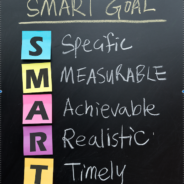
Smart Goals made easy
Hey SLPs
If you are thinking about your personal “smart goal” for the next school year you might want to check out my site on Teachers Pay Teachers. A few years back the SLPs in my district were asked to put together a short in-service for teaching assistants about the role of the SLP in schools, students we work with and how they can support language development in the classroom. This was to satisfy one of our “smart goal” requirements. Since I did put a little bit of work into it I decided to make it available on TPT. The in-service is titled Speech and Language Services In Schools In-service for Teaching Assistants. It is made up of a presenter’s packet and a packet for participants. The in-service is appropriate for all levels through middle school. When I presented this in-service I supplemented with generic guidelines for over language development/language expectations based on the ages the participants were working with. It is a quick and easy in-service. Administrators are always looking for appropriate in-services for assistants/paraprofessionals.
The other “smart goal” activity I presented was to write a monthly/bimonthly blurb in the school newsletter on language development and what parents could do to engage and encourage their child’s language. Several of these can also be found in my TPT store, The School Speech Therapist. They are available in Word so they can be edited to fit your newsletter or if you have other words of wisdom.
I would love to hear about other smart goal ideas. So many SLPs think they have to reinvent the wheel or take copious amounts of data to achieve their smart goal. Reality is it does not have to be that challenging and there is no reason not to share ideas.
One year many of my students had an objective to share 1-2 experiences. I made that one of my student smart goals, that every student would share experience information during each session. (They also had to show that the listened to each other by retelling others experiencesJ) That was so easy to keep track of and that’s how we started therapy.
I would love to hear about other personal and student based smart goals that have worked well.
The Essential 55-book review

I was dusting some of my bookshelves and found this book The Essential 55 by Ron Clark. I remember being very impressed with this book back in 2009 and even wrote a book review. Remember something is a few years old doesn’t mean it isn’t very good or passe. Common sense and good manners go a long way. This book went beyond focusing on successful students (which seems to be the only focus these days)…it focused on creating successful people.
From 2009 Your Middle Schooler: A Unique Age
I’m always on the look out for common sense ideas that enhance more than just academics. In my field of Speech Language Pathology, pragmatic skill development is as important to us as receptive and expressive language development. Pragmatic skills are the social speech skills that help us become effective communicators, critical thinkers and problem solvers. People who are not strong students academically can do well in life if pragmatic skills are well developed and expectations are high.
I recently picked up the book The Essential 55, An Award-Winning Educator’s Rules for Discovering the Successful Student in Every Child, by Ron Clark winner of the 2001 Disney Teacher of the Year Award. The title caught my eye, I see so many kids that are bright but seem to be lacking the tools for success. In the Essential 55, Ron Clark gives his opinion on the 55 rules that can make every child successful as a student. His rules are not on the order of study more, read more or stay after school for help. Clark’s rules are rules for life. The focus of the rules is on enriching pragmatic awareness, improving pragmatic skills and expecting basic etiquette. Not to mention his rules make sense.
The Essential 55 also focuses on providing clear cut expectations for a child. If you read my blog, you know I am BIG on providing expectations for children. Six of The Essential 55 that I like best are:
#1 Responding to Adults
Mr. Clark suggests that you tell/expect children to say, “Yes sir” and “no ma’am. He says it set the tone for the kind of respect he expects from his students. For him a nod of a head or a “yeah” is not good enough. I sometimes feel the child/adult relationships, especially in schools, are too casual. This is great tool for kids to have, saying, “yes sir” and “no ma’am” usually makes a very good impression on others.
#2 Eye Contact
Eye contact is so important in communication. When you make eye contact, you are attending to and acknowledging the speaker. From my perspective, eye contact is also important because without eye contact you miss many of the non-verbal cues that clarify messages. Plus it’s polite. When a child’s disability effects their ability to make good eye contact, I spend a lot of time trying to get eye contact to the best level possible.
#6 If you are asked a question in conversation, ask a question in return
This is an excellent habit to get into. Again, it shows people you are listening and interested. This is a good foundation for developing good conversation skills.
#11 Surprise others by performing random acts of kindness
This is an excellent suggestion and should jut go without saying. However, we all need reminders to do this from time to time. How many times have you said to yourself “I should have helped……..”, when regretting that you did help someone out. This one goes in effect at my house today. We all seem to be lacking in that lately. Recently, one of my very disabled students in the middle of a tough moment said to me “Stop being nice to me!” When I responded with a smile “No, I can’t do that, I am just a nice person”, he was so taken back by my kind response he calmed down almost immediately. A little kindness actually made a tough situation easier and almost humorous for me.
#15 Do not ask for a reward
Mr. Clark rewards his student’s often but asking for a reward is out of the question. He feels students should strive to do their best all the time not just for a reward. He states that in the real world rewards are not always given for a job well done. He feels that that this rule helps kids appreciate their efforts over their rewards.
#48 If anyone is bullying you let me know
He wants the kids to feel safe in school and know that he will stand up for him. Kids should never have to put up with bullying in school (we would not expect or put up with bullying at work). A big step to preventing bulling is to empower children to report bullying incidents since most happen out of earshot or view of adults.
If you notice Ron Clark’s rules are not just school or student rules they are rules for life. It was hard to pick just 6 to highlight. I would like to tell you more of them but you will just have to pick up his book.
With the Essential 55, Ron Clark has developed a “hidden curriculum”. A “hidden curriculum” is defined as the rules we all know but are never taught. I could see his Essential 55 presented weekly or expanded and presented daily at announcements instead of (or in addition to) “word of the day”.
This is a good read for both teachers and parents. The reality is if you expect good things from kids and are willing to teach them, they usually deliver.